
.svg)


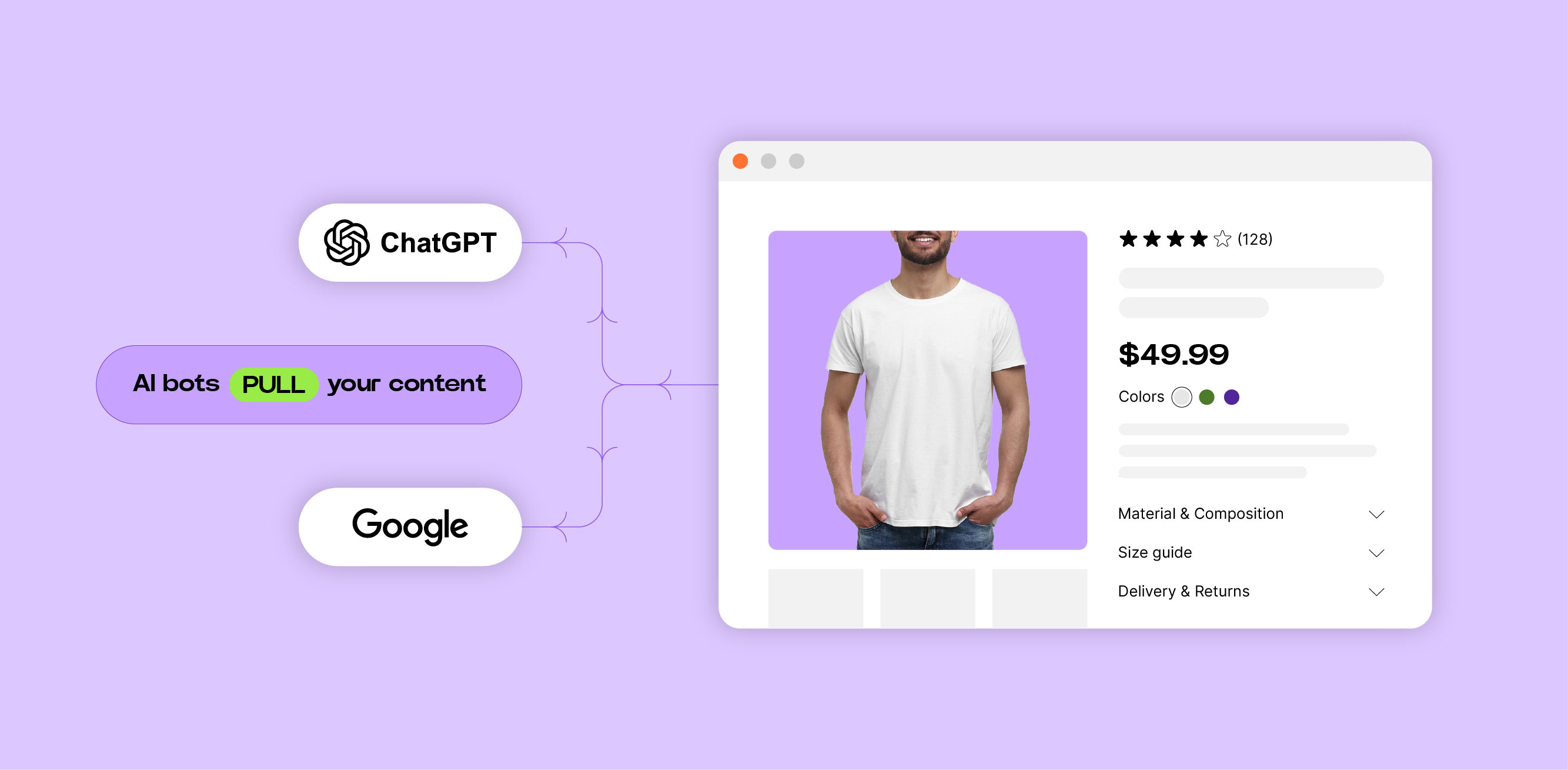
When an AI agent answers a shopper's question, like "What's the best waterproof hiking boot under $200?", it doesn't visit your homepage, scroll through your navigation, and browse your product pages. It queries an index built from crawling the web, pulling information from the content it was able to find and interpret.
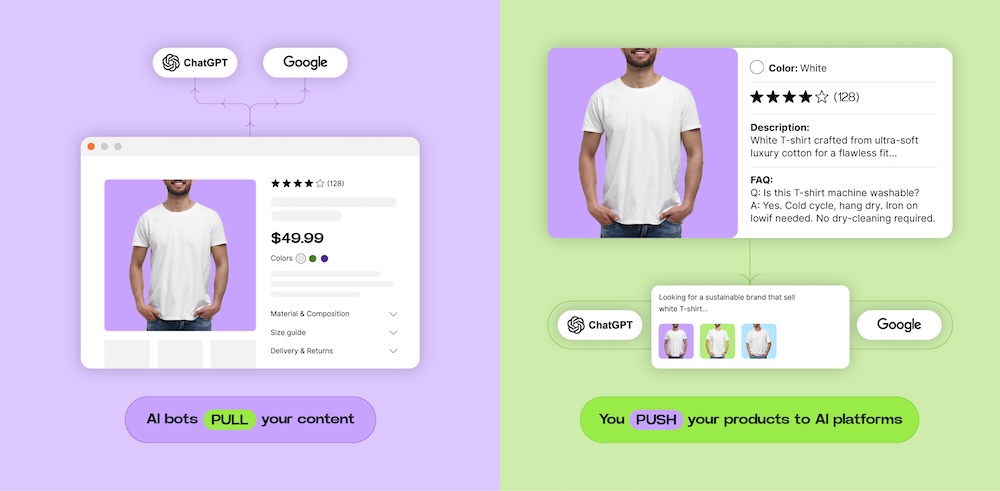
How AI bots and agents collect your brand’s data can be simplified into two concepts: push and pull. This is what we call the "pull", the content AI systems retrieve from your website through crawling. It's the counterpart to the "push" (product feeds sent directly to AI platforms, which we cover in a companion checklist here). Together, they give AI platforms the complete picture they need to make confident product recommendations.
While traditional search strategies still hold up when it comes to getting bots to crawl your site successfully, even brands with strong foundations may have significant gaps when it comes to AI agents specifically. To see where you stand, use this checklist to evaluate whether AI can actually find, read, and use the content on your site.
✔️ Can AI bots find your content?
Before you focus on anything else, your content needs to be discoverable. If AI crawlers can't reach your pages, nothing else on this checklist matters.
Ask yourself:
- Are your revenue-driving pages — such as product detail pages (PDPs) and product listing pages (PLPs) — being indexed and crawled by AI bots, not just Google?
- Do you have visibility into how much of your site AI bots are actually crawling?
- Is your internal linking structure helping or hindering discovery? Strong internal links guide crawlers to your most important pages. Orphaned or deeply nested pages may never be found.
- Are your revenue-driving pages being re-crawled frequently enough?
- Are you managing your crawl budget effectively? Too many low-value pages (thin PLPs, parameter variations, duplicate content) consume crawl resources that should be spent on your most important content.
Your log data files are your greatest resource for observing AI bot behavior on your site, so start by analyzing those to identify where any of the items above can be improved.
✔️ Can AI bots see and read your content?
Being crawled isn't the same as being understood. If your content is locked behind features like JavaScript, which AI bots can't render, it's effectively invisible.
Ask yourself:
- Is your content rendered server-side or in static HTML? Client-side JavaScript rendering is a known barrier for AI crawlers.
- Are third-party elements — such as reviews, Q&A widgets, or ratings — actually visible in the HTML that bots receive?
- Is all important information on your PDPs accessible in the page source? Every relevant detail should be findable by bots, not hidden in tabs, accordions, or other modules that require interaction to expand.
- Is your structured data (Schema markup) complete and up to date on your most important pages?
The gap between what a human sees on your page and what a bot sees can be enormous. If you haven't audited your site recently with AI crawlers specifically in mind, it's worth doing.
✔️ Is your content optimized for AI understanding?
Even when AI bots can find and read your content, the quality and structure of that content determines how well an LLM can use it. AI agents need context. Read your content through the lens of an AI agent trying to answer a specific question.
Ask yourself:
- Do your product descriptions explain what a product is for, not just what it is?
- Do you have quality images that put products in context? Lifestyle images alongside standard product shots help AI platforms (and increasingly, multimodal models) understand how a product is used.
- Is your content written for readability by both humans and machines? Dense marketing copy or manufacturer-supplied descriptions often fail to communicate clearly to an LLM parsing your page for relevant information.
- Are reviews and Q&A content present and substantial on your PDPs? These are high-trust signals that AI platforms weigh when deciding whether to recommend a product.
- Is your PLP-to-PDP ratio balanced? PLPs help with discovery, but creating too many thin listing pages to match every possible search intent can dilute your crawl budget and make it harder for bots to find your actual product pages.
✔️ Is your site fast and efficient for AI crawlers?
Speed matters more than many brands realize, especially for AI bots. OpenAI, Anthropic, and Perplexity don't have the crawling infrastructure that Google has built over decades. They need to find answers faster and process pages more efficiently.
Ask yourself:
- How fast do your pages respond to bot requests? Slow server response times mean fewer pages crawled in a given window, which means less of your catalog is represented.
- Are you delivering content in the formats AI bots prefer? Some prefer HTML, others may prefer something like Markdown. Offering content in multiple formats can improve crawl efficiency.
- Have you explored emerging standards like LLMs.txt or WebMCP as ways to deliver content more directly and efficiently to AI systems?
The faster and cleaner your site is for AI crawlers, the more of your catalog they'll be able to cover, and the more accurately they'll represent your brand.
✔️ Do you have a strategy and the data to back it up?
AI readiness requires a deliberate strategy and the measurement infrastructure to track progress and prove value.
Ask yourself:
- Do you have an AI readiness strategy that goes beyond traditional SEO? Good SEO is a prerequisite for good AI visibility, but it's not sufficient on its own.
- Do you have a bot governance plan that distinguishes between different types of crawlers and manages access intentionally?
- Can you track and report on traffic and engagement driven by AI sources specifically?
- Are your teams enabled and encouraged to learn about AI readiness, or is it siloed with one person or group?
Attract and hold AI’s attention
If you're strong on organic search foundations, you likely have a head start on the pull side of AI commerce, but don't just assume you’re good to go. Audit your site from the perspective of an AI crawler: what can it actually find, render, and make sense of? Start with your most valuable pages, identify where the gaps are, and build a plan to close them.
Remember, to give AI platforms the comprehensive understanding they need to recommend your products, you should combine your pull strategy with pushing your product data directly to AI systems. We built Botify’s AgenticCatalog for just this purpose — see how it can help here.
Our newest resource, The AI Readiness Guide for Retailers, can help you score your AI readiness and develop an actionable strategy for boosting your brand's AI readiness and being found everywhere consumers search. Download the free guide and get a practical framework to assess your AI readiness, close your gaps, and compete where discovery is happening now.

.svg)

.svg)
