
.svg)


AI platforms like ChatGPT and Google Gemini are quickly becoming the places where consumers discover and choose products. As you probably know, these systems don't browse your site like a human shopper would. Instead, they rely on structured product data to decide what gets recommended and what gets ignored.
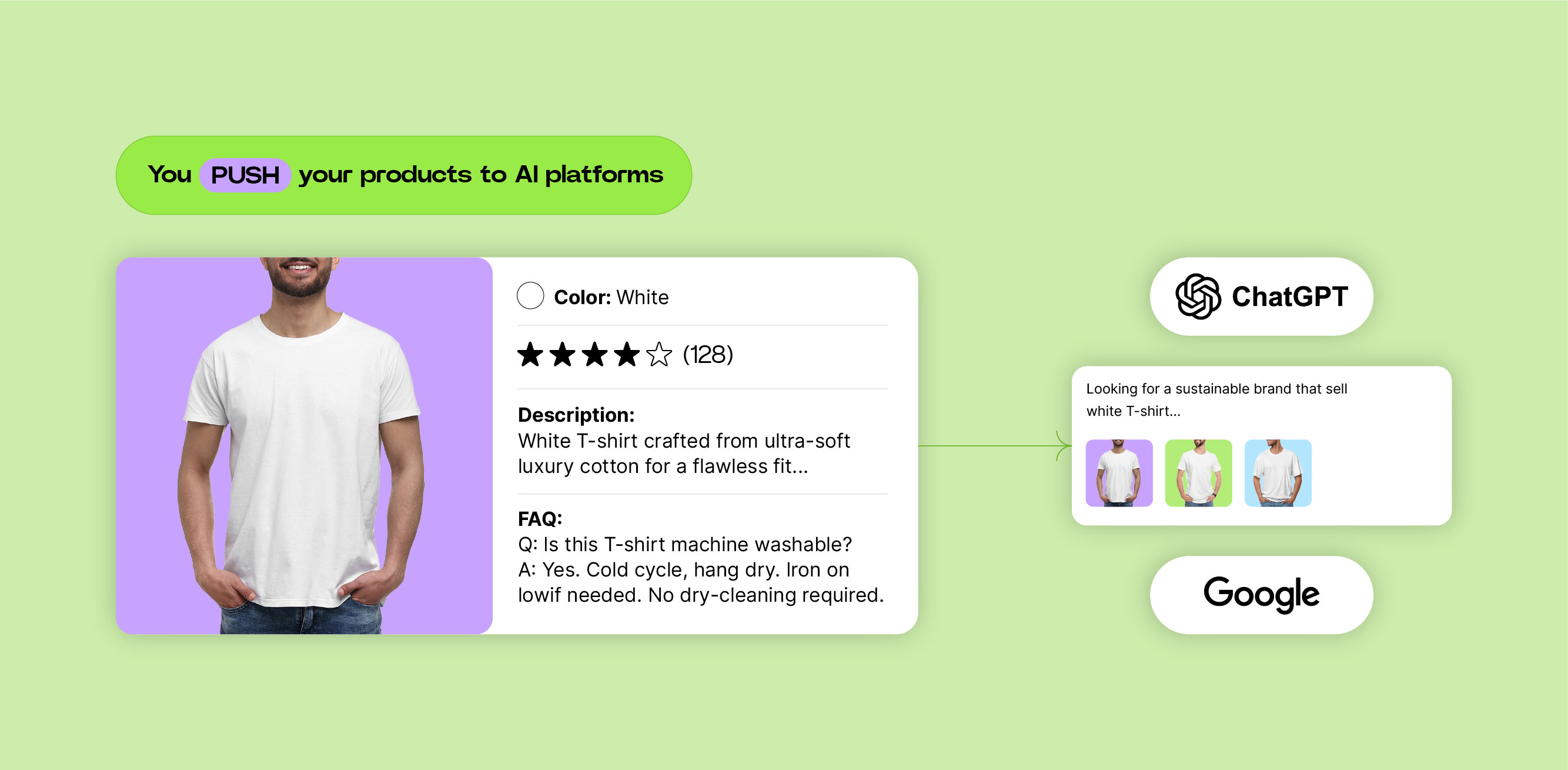
The way they gather that data can be simplified into two concepts: push and pull. The "push" is the product data you send directly to AI systems; this is distinct from the "pull," which is optimizing your site so AI crawlers can find and use your content. (We cover that in a companion checklist here.)
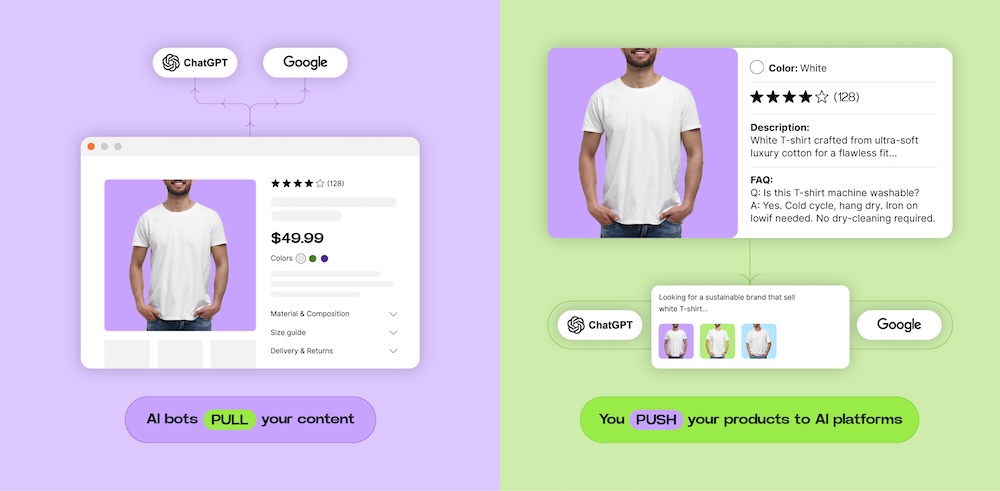
Both are essential, but the push is where many brands have the most immediate gap and the most immediate opportunity. To help, we’ve put together the checklist below to help you evaluate where your brand’s AI visibility strategy could use a push in the right direction.
✔️ Is your product data complete and accurate?
AI agents evaluate products based on the structured data in your feed. Missing fields could cause your product to be overlooked. For example, if someone asks ChatGPT for high-capacity washing machine recommendations and your feed doesn't include capacity as an attribute, you're invisible to that query.
Ask yourself:
- Are your core attributes — title, description, price, availability, brand, GTIN — filled out accurately for every SKU?
- Are your titles written for humans and machines? A title that's just a serial number won't engage a shopper or help an LLM understand what the product is.
- Are extended attributes — size, color, material, product type, condition — present and consistent? These are the fields AI agents use to match products to specific intent.
- Is your product categorization accurate? Google's product taxonomy, for example, has hundreds of specific categories. A pair of headphones classified under a generic "electronics" category risks being excluded from relevant results.
- Are fields like reviews, Q&A, and use-case context included? AI platforms use these signals to evaluate trustworthiness and relevance. A product described only by what it is (e.g., "replacement warmer part") without what it's for (e.g., "compatible with commercial fryers and HVAC systems") gives an LLM less to work with.
Audit your feeds and their attributes, starting with your highest-revenue SKUs, and identify where gaps exist.
✔️ Are your feeds protocol-compliant?
The Agentic Commerce Protocol (ACP) and the Universal Commerce Protocol (UCP) are new, open sets of rules that allow AI agents to talk directly to online stores. They're how the most popular AI platforms ingest and prioritize product data. Recently, Google announced the expansion of UCP and introduction of Universal Cart to enable purchases across different merchants in a centralized shopping experience. Now, protocol compliance isn’t just a good idea — it’s table stakes for being found in agentic shopping.
Ask yourself:
- Are your feeds formatted to meet current ACP requirements for OpenAI transactions and make payments through it secure?
- Are your feeds formatted to meet Google’s UCP requirements to facilitate the entire AI shopping process of major retailers, like WalMart and Target?
- Do you have a process for monitoring protocol changes and updating your feeds accordingly?
✔️ Can you keep your feeds fresh and scalable?
Product data changes constantly. If your feeds don't reflect your brand’s current reality, AI platforms may recommend out-of-stock products or display outdated pricing, thus eroding trust with the platform and the consumer.
Ask yourself:
- How frequently are your feeds refreshed? Can you support a daily update cadence? Weekly?
- If a product goes out of stock mid-day, how quickly is that reflected in your feed?
- Can your feed infrastructure scale across your full catalog? Enriching one hundred SKUs manually is feasible; enriching 100,000 is not, without automation.
- If you operate across multiple regions, languages, or pricing structures, can your current process handle that complexity?
✔️ Can you measure impact?
Sending optimized feeds to AI platforms is only valuable if you can connect that effort to outcomes. Without measurement, you can't prove ROI internally, and you can't improve over time.
Ask yourself:
- Can you track which of your products are being surfaced in AI-driven results?
- Can you attribute traffic and revenue back to your AI commerce feeds specifically?
- Can you run A/B or split tests on feed changes to understand what drives success?
- When leadership asks how your products are performing in AI commerce, do you have reliable data to answer?
If you can't answer these questions today, prioritize getting the instrumentation in place alongside your feed improvements.
Push optimized, enriched feeds to AI platforms automatically
The “push” side of AI commerce is exactly what Botify's newest solution, AgenticCatalog, is built to support, particularly for enterprise brands that can’t keep up with their current stack. It takes your existing product feed and enriches it with the contextual signals AI agents need to evaluate and recommend products, like reviews, Q&A content, and detailed attributes drawn from Botify's crawl intelligence. From there, it generates feeds compliant with emerging protocols like ACP and UCP and delivers them directly to AI shopping platforms including ChatGPT and Google.
Proactively push product info to be found in AI shopping
You don't need to solve everything in this checklist at once. Start by identifying your gaps in each section and focus on the lowest-effort, highest-impact optimizations. For most brands, that will be getting feeds live on AI platforms first, then systematically improving data quality, compliance, and measurement from there.
The window to build an early-mover advantage in AI commerce is still open, but it's closing quicker as more brands gain entry. The checklist above is meant to guide your strategy, but if your brand needs some extra assistance, be sure to request a demo to see how Botify can help.
Our newest resource, The AI Readiness Guide for Retailers, can help you score your AI readiness and develop an actionable strategy for boosting your brand's AI readiness and being found everywhere consumers search. Download the free guide and get a practical framework to assess your AI readiness, close your gaps, and compete where discovery is happening now.


.svg)


.svg)
